For decades, generating accounting entries (pólizas) has been one of the most repetitive and tedious tasks in accounting work.
Every income, expense, or adjustment had to be recorded manually, line by line, with the constant risk of human error and duplicate information.
But that is changing.
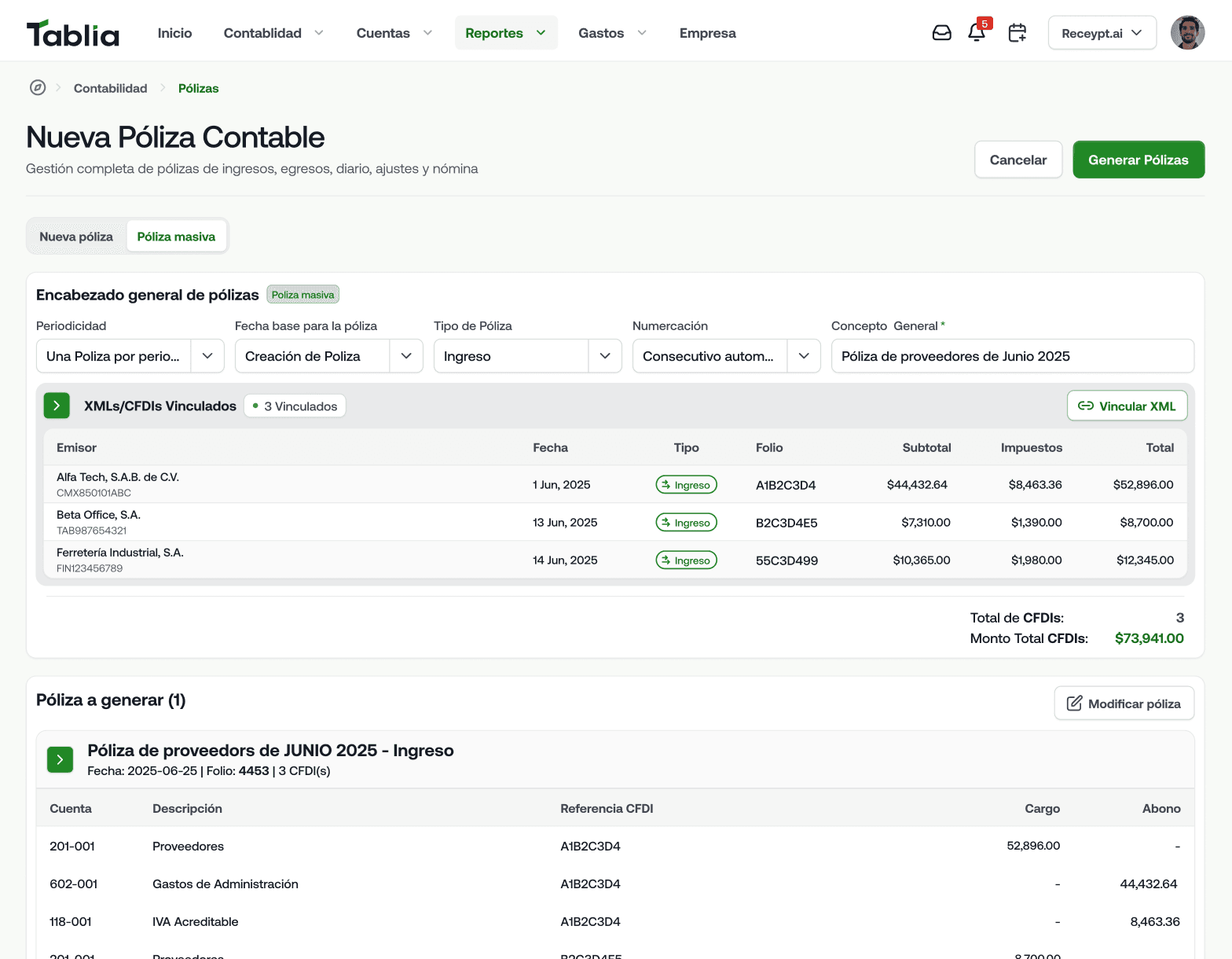
Today, accounting automation can already turn every CFDI issued or received into a complete, accurate, review-ready journal entry, without the accountant having to enter the data manually.
How does it work?
Modern platforms like Tablia connect directly to the SAT and to your bank accounts.
This makes it possible to identify the CFDIs related to a transaction and automatically generate the corresponding journal entries, applying the correct chart-of-accounts entries, references, and amounts.
In practice, the system:
- Detects and links the CFDIs associated with a transaction.
- Classifies the type of entry (income, expense, general journal, payroll).
- Automatically assigns accounts and cost centers according to the defined rules.
- Generates the accounting entries and prepares the reports for review or export.
All of this, in seconds.
Real benefits for the firm or the company
- Accuracy and traceability: every entry is generated from real CFDIs, with folios, UUIDs, and cross-references.
- Guaranteed compliance: the entries comply with SAT rules and current tax criteria.
- Time savings: teams can focus on financial analysis, projections, and internal controls instead of manual data entry.
- Accounting standardization: processes become consistent and auditable.
Accounting is evolving toward intelligence and full synchronization.
And those who adopt these tools first will be the ones who define the new standard of efficiency.
👉 Explore how Tablia automates your accounting entries and saves you hours of work every week.
Sign up: https://app.tablia.ai/sign-up