The change that redefines your operation in 2026
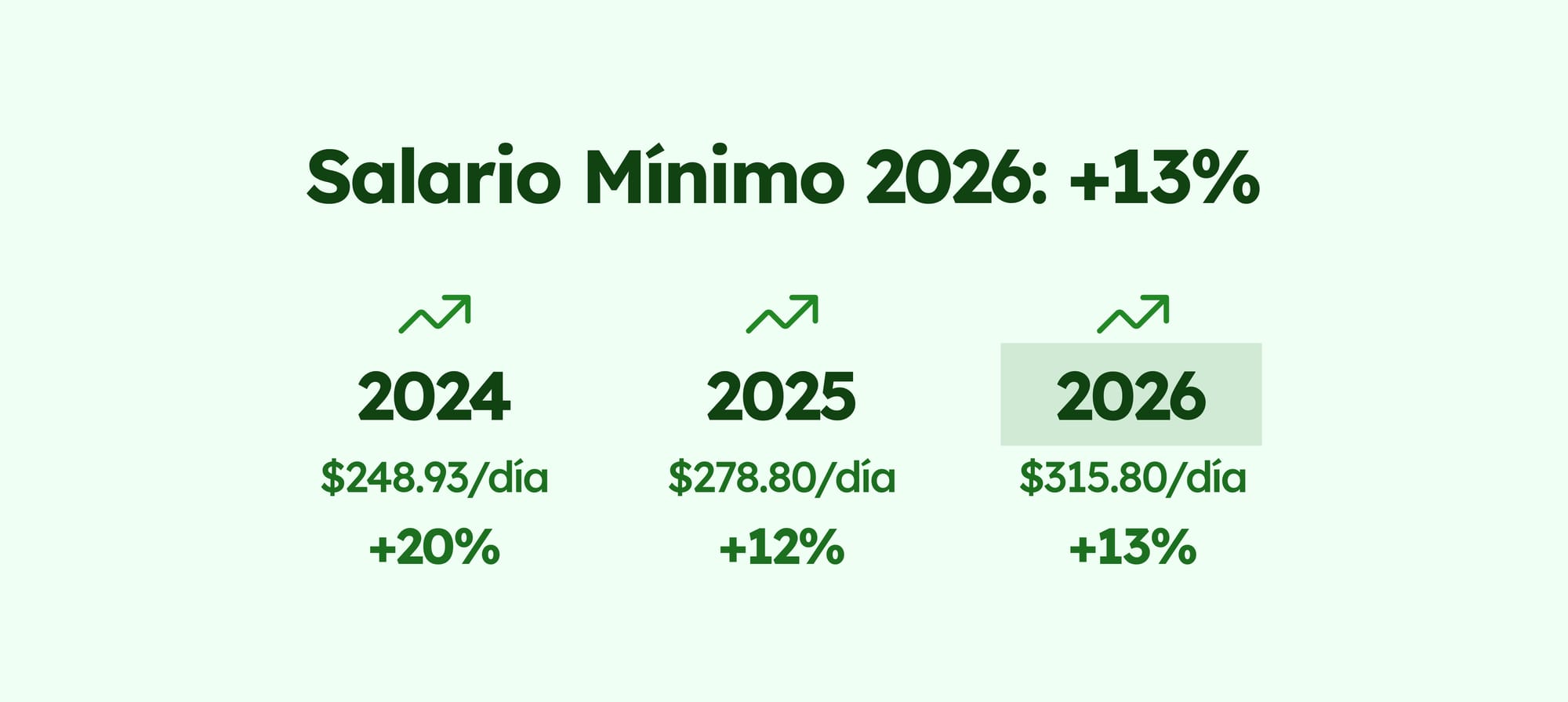
The minimum wage in Mexico will rise from $278.80 to $315.04 per day in January 2026, a 13% increase that officially aims to improve workers’ purchasing power.
But if you handle payroll, tax, or run an accounting firm, you know this goes far beyond updating a figure in the system.
This increase triggers a chain of operational, tax, and compliance adjustments that many clients aren’t seeing coming. And those who don’t prepare will face cost overruns, electronic audits, and deductibility problems in the first months of the year.
The context that changes everything
Let’s look at the full picture:
| Year | Daily Wage | Increase |
|---|---|---|
| 2018 | $88.36 | - |
| 2020 | $123.22 | +39% |
| 2022 | $172.87 | +40% |
| 2024 | $248.93 | +44% |
| 2025 | $278.80 | +12% |
| 2026 | $315.04 | +13% |
+256% cumulative growth over 8 years.
This isn’t just inflation. It’s a structural reconfiguration of labor costs in Mexico that affects contracts, withholdings, employer contributions, and all of your clients’ tax planning.
The 4 operational impacts you need to anticipate
1. IMSS and INFONAVIT Contributions
The minimum wage directly impacts:
- Contribution base for workers in the lower ranges
- Real cost per employee in sectors such as retail, construction, and hospitality
- Risk of class change in companies with many employees on base salary
Practical example: A company with 20 employees on minimum wage will see a monthly increase of roughly $1,500-$2,000 in employer contributions alone.
2. PTU 2025-2026
Although PTU (employee profit sharing) has caps (3 months’ salary or the average participation), the calculation bases rise automatically.
For companies that distribute profits, this means:
- Higher accounting provisions
- Cash flow adjustments for April-May 2026
- Recalculation of estimates if the fiscal year-end closed before the announcement
3. Severance and Final Settlements
The legal caps grow proportionally:
- Constitutional severance: 90 days + 20 days per year
- Seniority premium: 12 days per year
A worker with 5 years of seniority will go from a base settlement of ~$42,000 to ~$47,000.
4. Pressure on REPSE and Outsourcing Schemes
Specialized-services providers face:
- Tighter margins
- Greater temptation toward risky “mixed schemes”
- Higher staff turnover
Warning sign: If your clients work with REPSE providers, verify that their payroll CFDI are consistent with the services invoiced.
The hidden problem: when compliance becomes simulation
With each minimum-wage increase, low-margin sectors face a dilemma:
- Absorb the cost (reducing profitability)
- Raise prices (losing competitiveness)
- Look for shortcuts (increasing tax risk)
The most common “shortcuts” we’re seeing:
❌ Poorly structured mixed salaries
❌ Cash payments off the payroll
❌ CFDI with concepts that don’t reflect reality
❌ Simulating professional fees to avoid payroll
Direct consequence: Non-deductibility, electronic audits, IMSS problems, and SAT fines.
Conclusion: the value lies in getting ahead
The 13% minimum-wage increase is not an isolated event. It’s part of a sustained labor policy that will continue in the coming years.
The firms and consultants who understand this as an opportunity to add strategic value (not merely react) will clearly set themselves apart in the market.
Your clients don’t need you to tell them “the minimum wage went up.” They already know that.
They need you to tell them:
- How much it’s going to cost them
- Where their risks are
- What they need to do this week
That’s the difference between being a compliance accountant and being a strategic advisor.
Is your firm ready for January 2026?