
The invisible trap of manual control
“I’d rather do everything myself so I have total control.” If you’ve thought this about your accounting, you’re falling into a mental trap that limits your company’s growth. Manual control isn’t real control; it’s the illusion of control that keeps you busy without being productive.
Every hour you spend entering invoices by hand is an hour you’re not investing in generating new revenue. Every data-entry error you make costs you not only time in corrections, but potential tax fines. The “control” you think you have is actually controlling you.
What do you really lose when you do everything “by hand”?
Time you don’t get back: 30-40 hours a month spent on repetitive tasks a computer can do in minutes. Time you could invest in strategy, sales, or simply in resting.
Growth opportunities: While you’re entering invoices, your competition is closing new contracts. Operational work pulls you away from the strategic work that actually grows your company.
Accuracy and reliability: Humans make mistakes, especially on monotonous tasks. An error in an accounting entry can propagate for months before you catch it.
Scalability: If your company grows 50%, so does your accounting workload. With manual processes, your growth is limited by your capacity to process paperwork.
Peace of mind: Living with the constant question of whether you captured all the data correctly, whether you forgot an invoice, whether the numbers add up. The stress of manual control is exhausting.
The accountant’s new role in the age of automation
From data-entry clerk to analyst: Your accountant no longer needs to spend 80% of their time entering data. Now they can analyze trends, identify tax-saving opportunities, and advise you strategically.
From reactive to proactive: Instead of “putting out fires” with the tax authorities, they can anticipate problems and opportunities. Real-time reports let you make decisions before they turn into crises.
From operational to consultative: Your accountant becomes your strategic partner. They can spend time understanding your business, proposing efficiency improvements, and helping you plan for growth.
From solitary to collaborative: With tools like Tablia, your accountant can work collaboratively with you. You both see the same information in real time and can make informed decisions together.
From putting out fires to making data-driven decisions
The reactive (manual) model:
- You discover problems when it’s already too late to solve them
- You make decisions based on outdated information
- You react to crises that could have been avoided
- Your energy is consumed by emergencies, not opportunities
The proactive (automated) model:
- You spot trends before they become problems
- You make decisions based on up-to-date data
- You anticipate cash-flow needs
- Your energy is focused on growth and optimization
How to begin the mindset shift in your company
Step 1: Recognize the real cost of manual control Calculate how many hours a month you spend on basic accounting. Multiply by your hourly rate. Does that cost justify the “control” you think you have?
Step 2: Define what “control” means to you Is control doing everything yourself, or is it having total visibility into what’s happening in your company? Is it entering data, or is it making informed decisions?
Step 3: Identify which decisions require your human intervention Tax strategy, interpreting regulations, negotiating with suppliers: that requires your brain. Entering the RFC from an invoice: that doesn’t.
Step 4: Experiment with gradual automation Don’t automate everything at once. Start with a simple process like the SAT download. Verify it works correctly, build confidence, and then automate the next process.
Step 5: Measure results objectively Compare the time invested, data accuracy, and peace of mind before and after automating. The numbers don’t lie.
Automating isn’t losing control; it’s truly gaining it
Real control means:
- Instant visibility into your company’s financial status
- The ability to make decisions based on up-to-date information
- Time to focus on growing the business
- Confidence that operational processes run without your constant supervision
- The peace of mind of knowing nothing important is slipping past you
Tablia gives you real control:
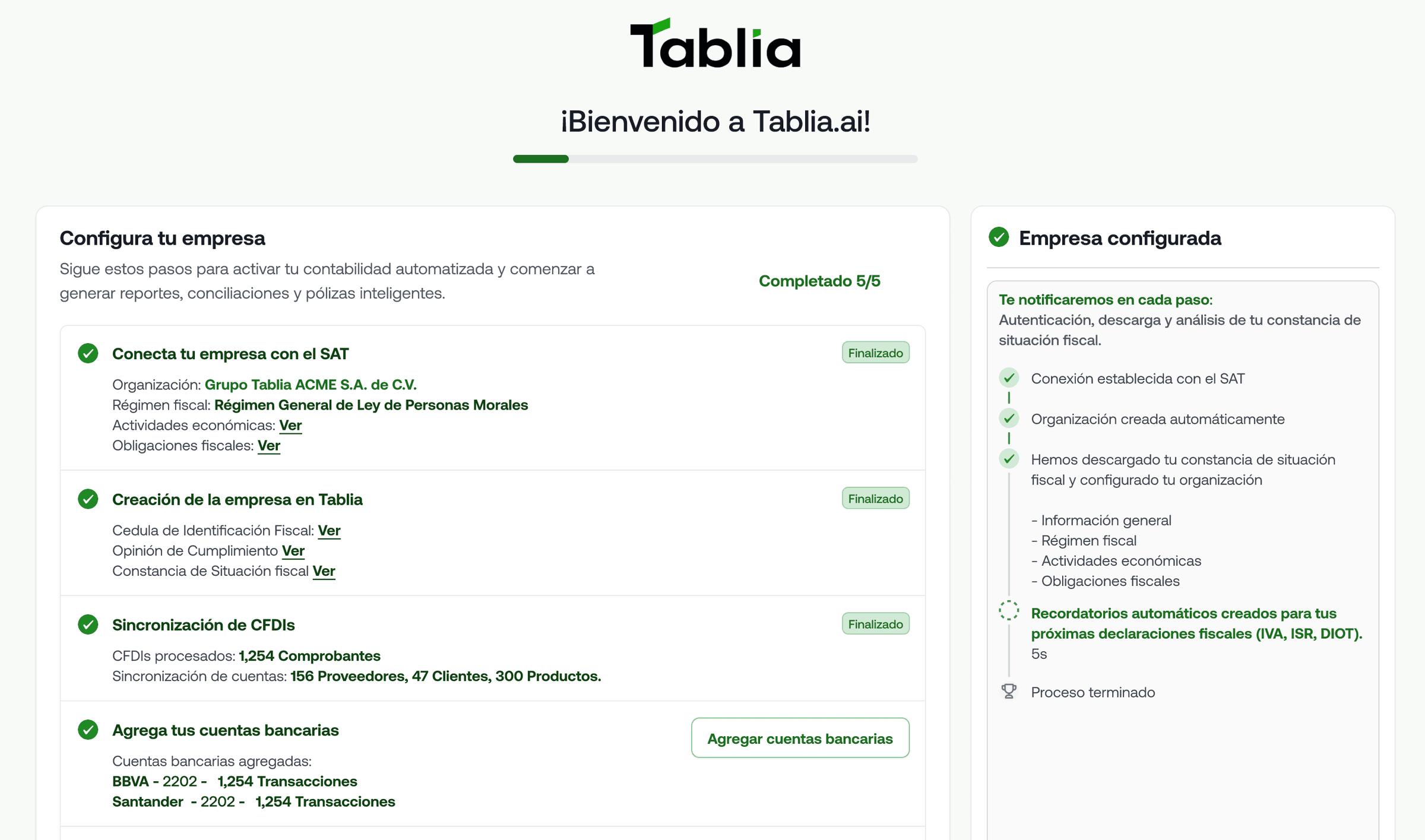
- A real-time dashboard with the status of your accounting
- Automatic alerts for everything that requires your attention
- Complete traceability of every automated process
- The ability to intervene manually when necessary
- Up-to-date reports that let you make informed decisions
The time to change is now
Every day you postpone automation is another day of unnecessary work, avoidable stress, and missed opportunities. Your company won’t grow more slowly by automating; it will grow faster because you’ll have the time and energy to focus on what really matters.
The question isn’t whether you can afford to automate your accounting. The question is whether you can afford to keep going without it.